 Book a demo
Act I — What Broke
For fourteen years we have built the infrastructure progressive organizations and campaigns run on. Implemented mobilizing tech, websites, CRM and data systems, distributed organizing programs. Some of it worked. Some of it made the thing I am about to describe worse, and at times I was a part of the pattern.
Over the next thirty days I am going to make one argument in thirty pieces. It starts with what broke in our politics. It moves to why your organization cannot get out from under it. It takes the AI question seriously enough to name what it costs. And it ends with what I think we should be building instead: technology that promotes real organizing, instead of replacing it.
My team is building a platform, an organizing center, designed to do something I haven't seen any other civic technologists take a swing at in quite the same way: to put politics back into the hands of the people.
Act I is about the world. It does not get comfortable.
Making the relationships that matter count
by Ned Howey
It is fairly common thinking these days that if a campaign has to change someone's beliefs in order to win then, as one colleague put it to me, the campaign is fairly doomed from the start. I think that belief has hardened over my time in this work, as campaigning has become steadily more transactional. So I went and asked someone who had done it.
In 1978, Proposition 6, the Briggs Initiative, sought to ban gay and lesbian people from working in California's public schools. It followed a run of similar measures in other states, every one of which the community had lost. No initiative had ever gone in favour of LGBTQIA+ people. Not once, anywhere.
A year earlier, Gwenn Craig had worked on Harvey Milk's supervisorial campaign, where he became the first openly gay man elected to office in California. Milk asked her to co-manage the to defeat the Briggs initiative. Gwenn is a dear friend, a mentor, a personal hero of mine, and now an advisor on the platform my team is building. I asked her whether they had genuinely believed they could change people's minds.
"Unequivocally YES. We sent our canvassers out to talk to the voters they encountered with scripts that asked them what they thought about the Briggs Initiative and then asked if they realized that the initiative would do x, y, and z, and get their reactions to the facts that they were presented with…
Moreover, we believed that there were extremely powerful and effective attributes from the very fact that the voters we encountered were being given the opportunity to address a subject matter that they rarely had the ability to discuss, debate or even hear about from someone they might presume to be gay or lesbian, or at least an ally. These brief encounters seemed to break down barriers, bring about some inkling of familiarity, and perhaps even destroy some of the stereotypes that John Briggs was depending on for the passage of his heinous legislation. In those few minutes of a short exchange, perhaps those voters could see that this canvasser was not unlike their coworker, their next door neighbor, or the deacon in their church. They got to have that moment of humanity at their front door and that might have made more of a difference than anything else."
The initiative was defeated. It stands forever as the first victory of its kind.
It is not so different from a good number of rooms I have stood in since. And those volunteers, and what they did at the doors, are what won it. Gwenn became the face of the campaign that made history. What started as a campaign turned into a movement. And everyone knew Gwenn.
Four minutes at a door, in 1978, against a losing streak, in places where nobody expected it to work. Not a message. Not a media buy. A person, standing in front of another person, being harder to hate up close than in the abstract.
Now notice where that work sits in the hierarchy of our profession. Strategy is the senior job. The volunteers are what you hand to whoever is most junior in the room, and the doors are what you do until you are promoted out of doing them. Nobody writes this down. Everybody knows it. Check the salary ranges, if you doubt. The hard work of people is poorly compensated.
There is a reason for that, and it is not the one people assume.
The relational work is the only part of politics that cannot be bought, briefed or signed off. Everything else can. Strategy can be purchased. Creative can be commissioned. Data can be licensed, media can be booked, and every one of them can be approved in a meeting by someone who will never meet a voter.
A relationship can only be held- by a one person, with another particular person, over time. That makes it look unskilled, because anyone can talk to their neighbour. It is in fact the only unbuyable thing in the entire enterprise.
And this was the crux of the mistake. We mistook what cannot be delegated for what does not matter. And then, because we could not delegate the real thing, we started calling delegable things by its name.
I have lost count of the number of times I have been told that an email newsletter is how an organization builds relationships with its people. That taking donations is a form of organizing. That a petition builds power. I have sat with people describing the movement they are growing who are, on any honest inspection, growing a list and mailing it.
The test takes about fifteen seconds. Ask them who those people are.
Not how many. Who. What are they worried about? What would they turn up for? Which of them knows any of the others?
Here are some people who can answer that. Hahrie Han, Elizabeth McKenna and Michelle Oyakawa spent years studying the organizations that actually manage to build power, and in Prisms of the People they quote a leader describing his own membership:
"When you asked [how big our] membership [is], I'm going to tell you 300 people, and I'm going to be super proud of those 300 people, because those 300 people come to the meetings, those 300 people, I know their children, they know my family. We know their stories, what they went through, and it's taken us ten years to develop those 300 people, and that's a powerful piece… I could also tell you [that] we have 20,000 likes on Facebook. I could also tell you our email [list has] 120,000 [names], all those sorts of things, but those aren't real."
Ten years, for three hundred people. And he is proud of it, in front of a number six hundred times larger that he considers not worth mentioning.
So let me say plainly what I mean by a relationship, because there should be no confusing it past this point.
The anthropologist Robin Dunbar found that we can each sustain somewhere around 150 meaningful relationships at a time. Not contacts. Not followers. People who can actually move us.
You can picture their face reacting to something you might say. You can hear the tone they would answer in. You know roughly what is worrying them at the moment. They can make you feel like you belong somewhere, and they can make you feel shut out, which is the same power viewed from the other side. And you are connected to them in a way that is not really about information at all — you owe them something, and carry an ethical responsibility to them - even if that debt was never negotiated.
Emmanuel Levinas, my favourite philosopher, built most of his work on that last point. His argument was that our responsibility toward another person does not follow from understanding them. It comes first. Before we have worked out what we know, or who we are, or what the world is, the obligation is already there. He says that when we experience the face of the Other, we know an ethical implication to their right to exist and therefore a responsibility to their being. Not the idea of a person. The face.
Which is why empathy at a distance behaves so strangely. I can care about people on the other side of the planet, and I do, but the caring runs along wires laid by the people I actually know. We may feel for the far away. We act because of the near.
This is the part that matters, and it is the reason any of it is worth the trouble. What has the potential to change us is not information, and it is certainly not volume. It is the felt fact that a particular person, maybe one we are actually in relationship with, whose face we can picture and whose regard we would rather not lose- They can move us. And might.
Nothing on a list can do that. A person who cannot move you cannot change you, and almost nobody in our politics is now positioned to move anybody.
And this is the whole game, because of what democracy is for.
If democracy is only a survey of where everyone already stands, then a list is fine and a poll is better. But that is the thin version. The thick version, the one worth defending, is a process in which a group of people arrive somewhere none of them started, together. In The Age of Junk Politics I put it as: we transform ourselves, and then we present ourselves before the other. (That does sound a bit hippie dippy. I believe it anyway.)
It goes to say, we cannot actually transform anybody. That is not a thing one person can do to another. All we can do is hold open a space where somebody might do it themselves: through connection, or through conflict (both of which work). Ask anyone who has spent time pulling people back out of white supremacist movements. They will not tell you they won an argument. They will tell you they stayed in the room.
For any of that to happen, people have to be able to turn up as their whole selves rather than as a role. That is a shorter list than it sounds, and I have found it holds up:
What meaningful participation actually requires
Agency and the will to participate with meaning, not just the ability to follow instructions
Their values, life experiences and identities present in the work
The ability to make decisions, commit errors, be responsible, and learn
Sustained and growing relationships, with the organizing entity and with each other
The deeper things only this person brings: insight, creativity, strategy, skills, networks, their own sense of which issues matter, leadership
Mutual accountability with the organizing entity and the power of being part of something real, rather than being extracted by it
Hold that against a petition signature and you can see the size of the gap.
Now, three objections, all of which I get every time, and two of which are good.
The internet has made this genuinely confusing. I have working relationships with people I care about deeply whom I have only ever met on a screen. I know their faces and their voices and their kids' names. That is real, and anyone who tells you it isn't is being sentimental about geography. Social media is a different animal. It is built to give you the hit of connection while withholding the thing underneath it. You can spend four hours arguing with strangers and end up with the dopamine of contact and none of the part of your nervous system that actually settles when you are sitting somewhere laughing with a friend. Shared words without the human underneath them may be the most dangerous thing we have built for the possibility of dialogue.
Every time I write about real-world organizing, somebody tells me it excludes disabled people. I take this one seriously. I live with neurodivergence and a genetic chronic illness, and I have had plenty of days where I could not get out of bed. This is not an argument for making participation harder to reach. It is the opposite. It is an argument that the axis is depth, not geography. A phone call with someone I love, about something that matters, beats a scripted door-knock where I never show up as myself. The work is to find the accessible routes to real connection (and there are many, suited for different needs, strengths, and abilities) rather than accepting transactional contact as the accessible option. Those are not the same thing, and treating them as the same is how we ended up here.
And people tell me it is human nature to keep to ourselves. That we are fearful, self-protecting, tribal (I hate that word in the pejorative, and using only here because I hear it so frequently). The science points the other way. Scientists are genuinely unsure whether we were more intelligent than the other species in our genus; Neanderthals had brains as large as ours, made sophisticated tools, buried their dead, cared for their injured. The leading hypothesis for why we are the ones still here is not individual brilliance. It is connectivity. Our groups were larger and more interconnected, so an innovation could travel between them instead of dying out with whoever thought of it. Which means much of what we call human intelligence has never sat inside any one person. It sits between us.
Democracy is the structural expression of that advantage. A fair process for deciding together, which works better the more different the people in it are, aimed at outcomes that are better in the long run for the group. It is not a nice idea we invented. It is the institutional form of the thing that got us this far.
It is easy to argue with an idea. It is very hard to argue with a person standing in front of you. Most people who despise a group have never knowingly known one of them- maybe they met somebody once, briefly, who annoyed them, and never got close enough to find out what they had survived. You do not fix that with a broadcast. Gwenn's canvassers fixed it, four minutes at a time, in 1978.
None of which means a mass email cannot start something. It means we shouldn’t stop there. We are running all marketing and no sales, sure, it’s a terrible capitalist metaphor for civic life, but unfortunately the right one.
The web we would need is already there. Nobody is on an island, and I am not talking about the internet. I mean the ordinary fact that people know people, who know people, and that you could probably reach anyone alive through a chain of them. The law of Kevin Bacon if you will. We do not have to manufacture that. We have to get inside it, and then help it hold.
Which is what distributed structures are actually for. In 1954, at the height of Peronism in Argentina, something on the order of 27% of the population held membership in a political organization. The equivalent figure in the United States today is around 0.4%. That was not achieved by better messaging. It was small groups, locally run, at enormous scale with depth and reach at the same time. This is exactly the trade-off everyone tells you is impossible.
And here is the part that should bother us most. When my team surveyed campaigners across Europe about what makes a campaign work, roughly three quarters said supporters should be organizing their own actions. Under a third of their organizations actually run campaigns that way. The further along the spectrum you go, from broadcasting, to mobilizing, to people genuinely organizing themselves, the wider the gap gets between what practitioners believe and what their organizations do.
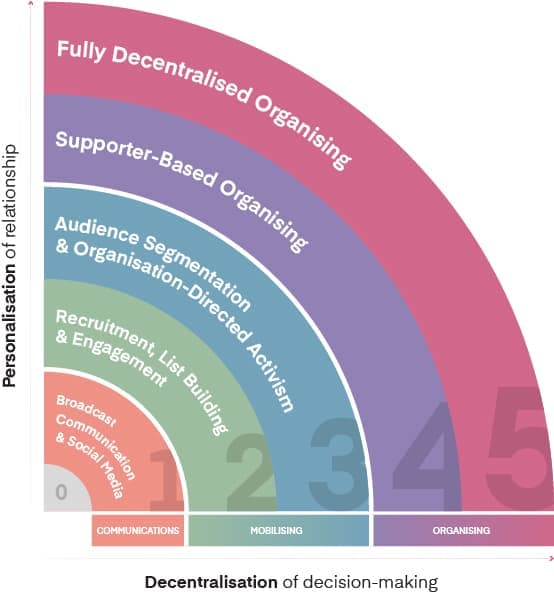
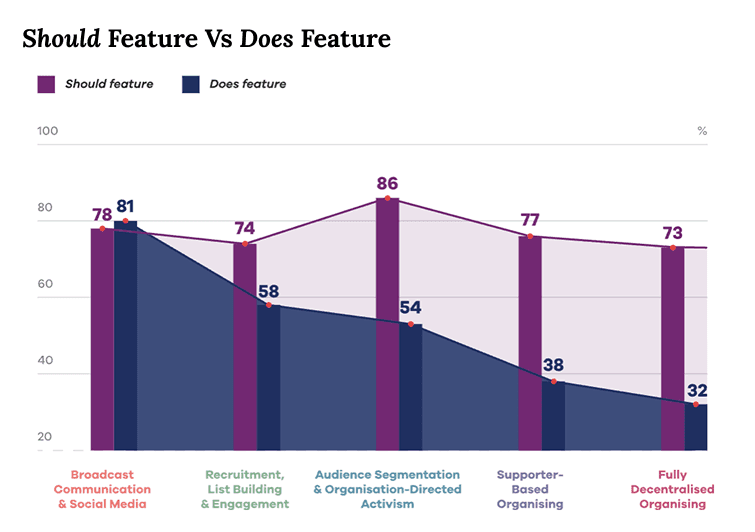
Nobody in that survey was confused about what works. They were doing the opposite anyway.
Generative AI, dropped into this without a thought, will make it worse. It will triple the volume of the spam and halve the cost of the broadcast, and it will do it faster than we can argue about it.
It does not have to go that way. The same tools can make the poster that actually fills the room. They can help somebody draft an invitation that sounds like them rather than like a committee. They can sort the logistics of a gathering, and work out which forty people you already know and ought to call. None of that replaces the four minutes at the door. All of it is in service of getting more people to those four minutes, more often, with more of themselves intact.
That is what my team has spent the last stretch building, and on September 15th I get to show you.
This is a reflection on how he got here, and why we need innovations built for people power. Ned Howey has spent fourteen years at Tectonica building organizing infrastructure for progressive movements.