 Book a demo
Act II — The Trap
The same solution has been chosen at every level.
If you are on the staff of an organization, the safe move is to keep the real work at headquarters. Handing it out to supporters is more work than doing it yourself. If you are in leadership, the safe move is not to stake the organization's name on people you cannot supervise; it could explode, in an environment already contentious enough. The alternative looks like chaos — things done wrong, in public, at the worst possible moment. And our political tactics have grown complicated enough that doing this well is hard for anyone who doesn't do it all day, for a career.
Everyone acted rationally toward their own mission or campaign. The sum of it is a passionate public who were never given anything real to do, inside a politics that wonders where its base went.
I am not going to spend this act telling you to trust your people. That advice has been on offer for twenty years and the people ignoring it had good reasons to. The question is harder: what would it take to entrust real political work to everyday people?
You wanted to try people power but were afraid to
by Ned Howey
An organization came to us a few years ago wanting to work out how they might innovate beyond the digital-first approach they were already running and seeing decreasing returns on - like those described in the previous chapter. Ordinary enough conversation. Then, in the second session, the tone changed. They had tried this before. "People power." And what was left of it was a certain sense of trauma.
They had gone from an organization that ran only online tactics to one that suddenly had groups meeting locally. Big organizing was a term they had heard and were quite excited about — it seemed like a catch-all, a way of starting a movement from nothing. So they launched groups, handed people the tools, and stood back, which is precisely what everyone was telling organizations to do at the time.
What came back was activities that could reflect badly on the organization's name. Things planned that nobody had any control over. Groups that simply disappeared. Leaders who dropped their responsibilities, and others who should never have been made leaders at all. And in that room, years later, a team still visibly frightened of letting its own supporters make decisions or carry any strategy themselves.
Nobody in that room used the word afraid. What we got instead was the language of strategy — the timing hadn't been right, they'd learned a great deal, they would want to be much more careful about scope. All of it true. None of it the reason. It took a few more conversations before somebody said plainly that they were frightened of it happening again, and that sentence did more work than any of the others.
Ask directly and the fears come out fast, and they are always concrete. A volunteer saying something publicly on behalf of the organization that gets picked up by the press. A group that turns into somebody's private kingdom. A leader who burns out and takes three people with them. The whole structure folding the week the one competent person moves house. And the one that has happened to everybody: the volunteer who was excellent for two years and then, quite suddenly, wasn't.
I have seen every one of those. They are not hypothetical and I am not going to pretend they are.
But notice what they have in common. Not one of them is a fear that the work won't get done. Every one is a fear about what gets done in your name — and underneath that, about who is answerable for it when it does. In politics, reputation is the currency. A volunteer's mistake costs the volunteer very little. It costs the person who decided to let them.
That is a difficult sentence to say out loud in our sector, because our entire moral vocabulary runs on believing in people. So it doesn't get said. It gets translated, somewhere between the thought and the mouth, into the language of strategy. We're not ready. It's not the right cycle. We don't have the capacity for it this year. All true. None of them the reason.
If you want to find your own line, it is easy enough to test. A group leader you trust — someone you developed yourself — runs the event you asked for in a completely different format, because she knows what actually gets people out where she lives. Comfortable? Most people are.
Now she decides the campaign you handed her group is not the fight that will move anything locally, and picks a different target — connected to the same goal, chosen by her.
That is usually where it stops, and it is worth asking why. Because that second decision is the one that requires knowing the ground, which means it is the judgment you would most want a local leader making. It just doesn't feel like hers to make.
So here is the part I actually want to argue, because it is where twenty years of this has gone wrong.
The programs that blew up did not blow up because people were given too much autonomy.
They blew up because autonomy was handed over without the things that make autonomy survivable. Nothing agreed about how the groups would actually work, before they were handed the authority to work however they liked. Nobody clear on what a group could decide for itself and what it couldn't. No way to correct course early, while a problem was still small and cheap to fix.
But from inside the wreckage, that is not what you see. What you see is: we let go, and it went wrong. The visible variable is the letting go. The invisible one — that we let go of the wrong things, in the wrong order, with nothing underneath them — does not announce itself. So the lesson that gets learned is that autonomy is the danger.
And this is not a peculiarity of political organizations. It is closer to a law of groups. Colin Fisher, who studies how groups actually function, reports an experiment in which struggling teams were asked what they would change to fix themselves. Eighty-four percent changed their processes. Sixteen percent changed their personnel. Five percent changed their structure — which was the change that most reliably worked.
Nineteen groups out of twenty, handed a free hand to repair themselves, reach straight past the thing that would have helped.
So the organization sitting in that meeting had not made an exotic mistake. They made the ordinary one, at the ordinary rate, and then paid a wildly disproportionate price for it.
Then comes the part that does the lasting damage — and it is not the failure. It is the response to the failure.
Control comes back in. Sensibly, and with good intentions. Everything routes through staff review. Groups become chapters that hold meetings and submit requests. Nobody ever says we don't trust our people; the language is all quality, consistency, being careful. And the program never fully recovers, because what has quietly been decided is that this will not be attempted again.
Here is what that costs. Holding tighter produces the very failure it was protecting against. Slower, and in a form nobody has to write up. Leaders never develop, because there is nothing left to develop them on. Nobody outside the building learns to carry anything — which leaves a handful of people on staff carrying the weight of a whole society, as if they ever could. And then a crisis arrives — they do arrive — and there is nobody else who can carry it. Which is the same place the collapse got to, only quietly, over four years, with no single incident anyone can point to.
There is a slide I use in workshops with two lists on it.
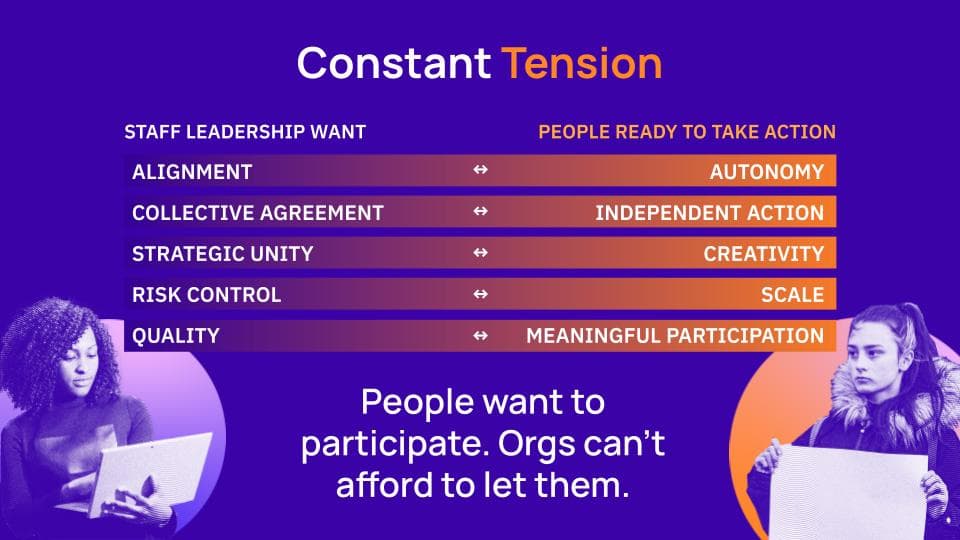
Staff leadership want alignment. Collective agreement. Strategic unity. Risk control. Quality.
Community organizers want autonomy. Independent action. Creativity. Scale. Meaningful participation.
Both lists are reasonable. Every item on both is something a serious person ought to want. And then the last line of the slide, which is the one that makes rooms go quiet:
Your supporters want to do more. You can't afford to let them.
We say we trust people, and we design everything as though we don't. Not out of bad faith. Out of an entirely accurate memory of what happened the last time.
Go back to that organization and ask not what went wrong but what was absent, and the list is short — and none of it is about autonomy. Nobody agreed how any of it would work before handing out the authority. Nobody was coached into leadership; warm bodies were activated and then called leaders. Nobody ever said, in writing, what a group could decide alone and what it couldn't — and then the rules changed anyway, under pressure, which is worse than never having had them. There was no way to part company with a leader who had gone wrong. And there was no feedback loop, so nothing surfaced while it was still small.
Which brings me to the trap, and it is worth being precise about it, because it is not a failure of nerve.
An organization tries the only thing that would put real political work in people's hands. It gets badly hurt doing so. It concludes, on the evidence in front of it, that the thing itself was dangerous. And unless somebody eventually says the real fear out loud, that conclusion is never revisited — because the conclusion was reasonable.
Nobody argues their way past a scar.
This is a reflection on how he got here, and why we need innovations built for people power. Ned Howey has spent fourteen years at Tectonica building organizing infrastructure for progressive movements.